Explocationers
Pre-K Development Guide
Pre-K Development Guide
Couldn't load pickup availability
A gentle guide for parents who really want to see their four-year-old
Your four-year-old is on a big journey of discovery. Whether you’re homeschooling, traveling the world with your family, or simply curious about what’s going on inside that little head — sometimes you want a little guidance. No tests, no checklist for your child to “score” on, but a guide that helps you see what’s happening now and where you can go from here together.
That’s what this development guide is for.
What it is — and what it isn’t
This guide is an observation tool for you as a parent. It shows what a four-year-old may begin to discover — across language and literacy, math, motor skills, social-emotional development, self-management, and understanding the world. No minimum your child must meet. No standard to measure them against. Instead, a quiet, expert lens that helps you see where your child stands now and which small next steps follow naturally.
What you won’t find: worksheets or homework for your child. The guide is written for you, not for your child. What you will find: an observation guide for each developmental area with key indicators, plus playful tips to support that development along the way — counting steps to a monument, spotting letters on a market sign, sharing snacks fairly. Nothing required; you pick what fits the moment, or skip it. Play and everyday moments are the material; you bring the lens to see what’s happening.
The guide is grounded in a clear view: young children learn everywhere. On the beach, at a market, on a winding path, in the sand. This doesn’t require an expensive method — just a parent who sees what’s happening and knows what it means. The guide is based on widely recognized Pre-K developmental milestones and child development research, translated into recognizable moments in daily life — so you can follow your child from an observing role, not a testing one. The goal is not to meet any single curriculum; it is to notice and nurture what your child is naturally ready to learn.
For whom
For parents who take their child seriously as an individual. Worldschooling families who want to know along the way whether they’re covering the core areas. Homeschoolers who follow their own rhythm but want a clear sense of which developmental steps suit this age. Parents deciding when (or whether) to begin formal schooling. And parents who simply want to understand their Pre-K-age child better, at their own pace.
A close that also yields something
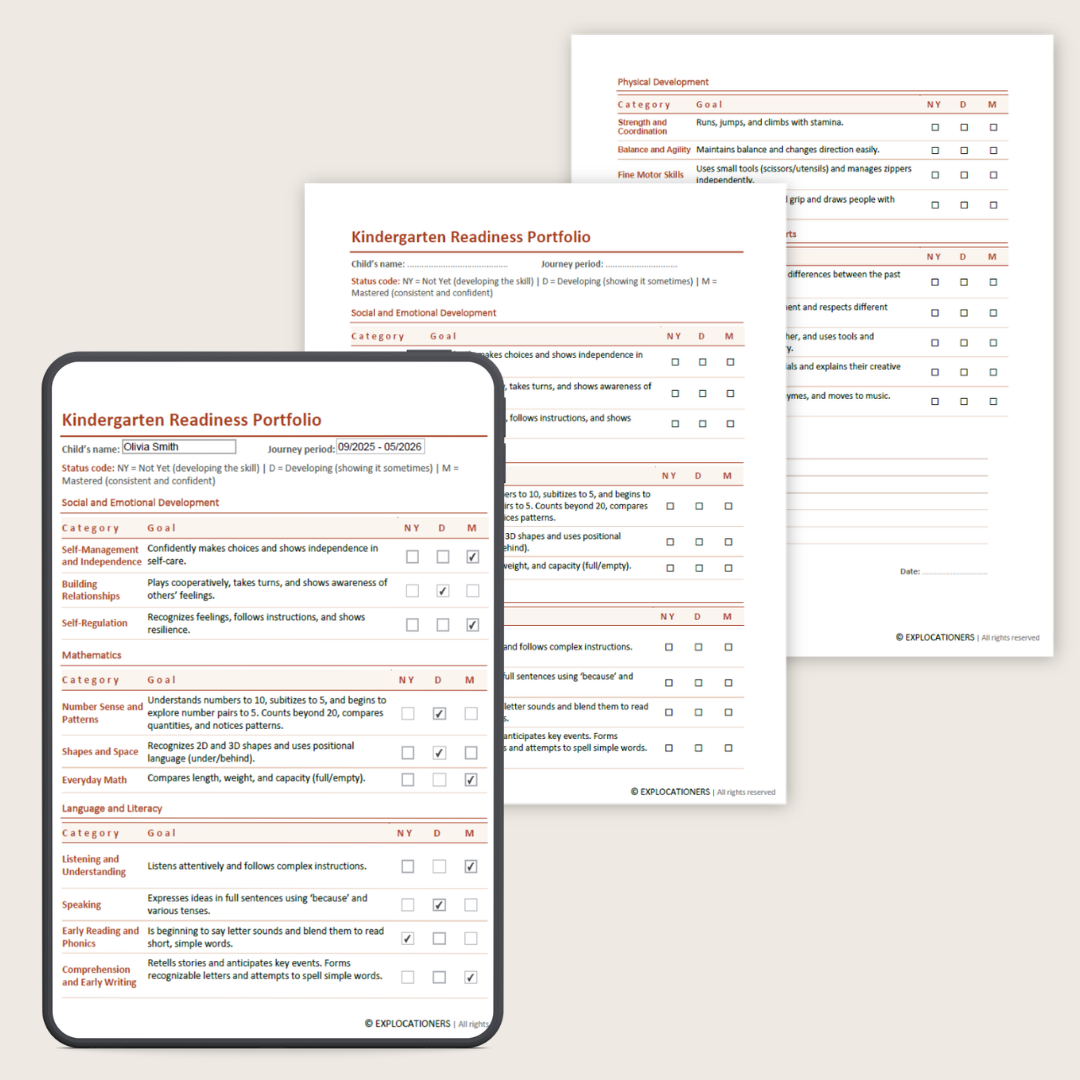
At the end of the guide, you’ll find a Kindergarten Readiness Portfolio and an Explorer Diploma. The portfolio sets out clearly which developmental milestones your child has reached this year and where they are still growing.
For traveling families who eventually return to a school setting, this is a useful handover document: you show the teacher in a single page where your child stands. For families continuing at home or on the road, the portfolio serves as a benchmark — a record of the steps you’ve taken together and what to build on next, at your own pace.
The Explorer Diploma is for your child: a celebratory close to a year of growth, with space to write their own name and keep beautiful memories.
Print or Bundle — choose what fits
Print ($32,95) — two PDFs: a color version and a black-and-white version, both for printing. For parents who prefer paper and writing by hand.
Bundle ($39,95) — three PDFs: color, black and white, and a digitally fillable version. For parents who prefer to work digitally — on a laptop or tablet, easy to carry, nothing to lose — but who want the freedom to print a section now and then. You can complete the whole guide digitally and print only what you want to hold in your hands: the Kindergarten Readiness Portfolio to keep or share with a teacher, the Explorer Diploma to frame, or a chapter you’d rather have on paper. The Bundle gives you both options — useful if you’re not sure what suits you, or if you want the best of both.
Who I am, and why this guide
I’m Els — a teacher and a traveling mom. I know early childhood development from years of teaching, and at the same time I know what it’s like to see your child growing up outside of a classroom. I made this guide because I couldn’t find what I was looking for: something substantial you can rely on, that stays close to everyday life, without the tone of a school report card.
Practical
• Available to download immediately after payment
• Written for four-year-olds (Pre-K year)
• Grounded in widely recognized Pre-K developmental milestones and child development research
• One-time purchase, yours to keep
Still on the fence? Check out the preview first (PDF, 7 pages).
Share